
You Didn't Write That Message: Why WhatsApp Treats Templates as Contracts, Not Filters
WhatsApp doesn't filter business messages after sending - it pre-approves them as templates. Why that makes templates contracts, not content rules.


Catching up? This is Part 2 of a series. Part 1 covered why SMS couldn't solve spam and how WhatsApp inverted the architecture with a 24-hour user-initiated window. Part 2 goes inside the gate.
The pre-commitment
Pull up a WhatsApp message from your bank. Or your airline. Or your dentist. Look closely.
You are not reading something a business wrote to you. You are reading a structure that was written months ago, reviewed by Meta, classified by category, and stored in a database. The business filled in your name, your appointment time, your flight number. That's it. They submitted parameters into a shape they were not allowed to invent.
That's the rule for business communication on WhatsApp. Every message a business sends first goes through a template. Not most. Every single one outside the 24-hour user-initiated window. Even "your order has shipped." Even "your OTP is 234901." Even "your appointment is tomorrow at 9."
Why this rule? The alternative - let everyone send anything, then filter the bad stuff out - operates under different constraints. That alternative is SMS.
SMS validates at runtime. The message goes first. Then carriers run content-based filters, the CTIA tracks aggregate complaint patterns, the 10DLC registry checks the sending campaign, and TCPA litigation cleans up what slips through. All of that runs after the message has been delivered. The harm has to land before the system can react to it. That's why your phone still buzzes with student loan refinancing pitches at 7 AM on the morning of your last day of work - the day you are finally retiring.
WhatsApp made the inversion. Validation happens before the message exists. Meta won't let you send a message it hasn't already approved the shape of. Bureaucratic? Sure. It's also why a WhatsApp Business message brings a different level of credibility than an SMS - the channel is constrained at the source.
The business agrees, in writing, to the kinds of things it will say. Meta agrees to deliver them. Both sides know what the message looks like before the first one is sent.
WhatsApp validates before the message exists. SMS validates after it lands.
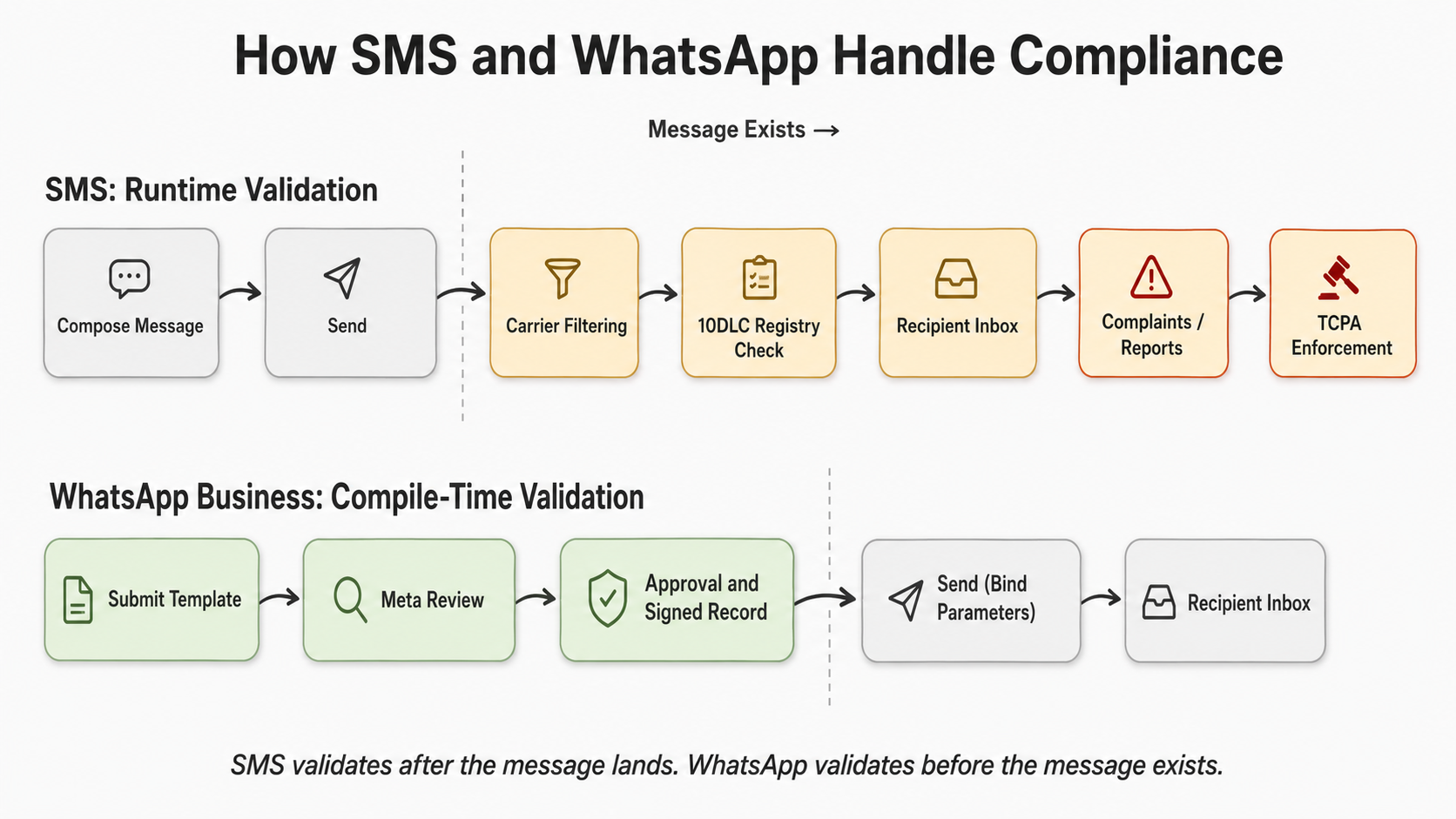
Templates as Prepared Statements
If you have ever written a backend service, you already know this pattern. You just call it something else.
A prepared statement is a SQL query with placeholders. The database compiles and validates it once, ahead of time. At runtime you bind the values - a User ID, a timestamp, an email - and execute. The shape was approved long before the call. The data is just plugged in.
A WhatsApp template is the same thing for messages.
- Template body = SQL statement with placeholders
{{1}},{{2}},{{3}}= bind parameters- Meta's approval = query plan validation by a DBA before anything runs
- Send-time = bind the values, execute, deliver
Here is what an approved template actually looks like:
| Field | Value |
|---|---|
| Template name | appointment_reminder_v2 |
| Category | UTILITY |
| Language | en_US |
| Status | APPROVED |
| Buttons | [Quick reply: YES] [Quick reply: NO] |
Body Hi{{1}}, your appointment with{{2}}is on{{3}}at{{4}}. Reply YES to confirm or NO to reschedule.
When the business hits send, the body is fixed. Only {{1}} through {{4}} change.
The reason prepared statements exist is not elegance. It is safety. You do not trust runtime values to be well-formed, well-meaning, or safe. So, you separate the shape - which is trusted - from the values - which are not.
WhatsApp's template system makes the same trade in messaging. The shape gets approved once. The values change every time. A business cannot smuggle promotional copy into a Utility template at send-time, for the same reason a well-built API cannot be SQL-injected through a parameterized query: the shape was locked before the values showed up.
Post-hoc filtering does not scale at the size of modern messaging.
Three reasons:
- The harm lags the signal. Carriers see content after the message is sent. Complaints arrive minutes, hours, or days later. By the time the filter learns, the damage has already shipped.
- The jurisdictional surface is huge. TCPA in the US, GDPR in the EU, LGPD in Brazil, PDPA in Singapore, DLT in India. Each defines consent, opt-out, and disclosure differently. A runtime filter must evaluate every message against every relevant regime, every time.
- Attackers iterate faster than filters. The 7 AM student loan pitch becomes a 7 AM debt consolidation pitch becomes a 7 AM credit repair pitch. Each variant defeats the last filter rule.
Pre-approval flips the cost. Validation happens once, at template submission, and applies to every message sent through that template afterward - whether it is sent once or ten million times. The expensive work happens at onboarding. The cheap work happens at scale.
Pre-approval moves the cost from runtime to onboarding.
The Category Is the Contract
When you submit a template for approval, Meta asks you one question before it reviews anything else:
What category is this?
There are three categories for business-initiated templates. (User-initiated messages within the 24-hour window are a fourth conversation type called Service, but those don't use templates - they're free-form.)
| Category | What it's for | Opt-in required | Relative cost | Example |
|---|---|---|---|---|
| Marketing | Promotions, offers, brand updates | Explicit, written, in advance | Highest | "20% off your next order" |
| Utility | Transactional and account updates | Existing customer relationship | Mid | "Your order has shipped" |
| Authentication | One-time codes, logins | User just requested it | Lowest | "Your code is 234901" |
The category is not a label. It is a declaration about which compliance regime applies to the message, and Meta enforces every line of the template against that regime.
- Marketing requires explicit opt-in - the customer must have said yes to receiving promotional messages from this business, in writing, in advance. A single opt-out blocks all marketing from that sender. Rate limits apply.
- Utility requires the customer to be in an existing transactional relationship. The opt-in bar is lower because the message is something the customer is already expecting.
- Authentication is the tightest scope. No upsells. No branding flourishes. No links to anything that is not the verification itself. URLs, media, and emojis are not allowed in authentication template content or parameters at all.
Get the category right and the message is reviewed against the rules you signed up for. Get it wrong and the compliance posture shifts under your feet.
This is where most businesses trip, and it is rarely an accident. The temptation is to dress a Marketing message as a Utility one. "Your account has new offers available." "Your subscription is about to renew at $9.99 - here is the link to upgrade." "Your loyalty status has been upgraded - click to see new benefits." Each is a promotion in utility clothing. Meta's reviewers know the pattern. They reject the template. Since April 2025, automatic category re-evaluation has been the default behavior - if a template is approved as Utility and the content drifts toward Marketing, Meta reclassifies it on its own and bills the new category from that point forward.
The category determines which rules apply, what consent must exist, and how the customers opt-out preferences cascade.
The category isn't a label. It's the rulebook
Signed Records
A WhatsApp template is not just approved. It is recorded.
Once Meta accepts it, the template gets a status, a timestamp, and an immutable identifier. The body cannot change without re-approval. The category cannot shift without re-review. The variables, the buttons, the header media - locked. If the business wants to alter a single word, they submit a new template, and Meta runs the review again from scratch.
This is what makes the template an audit artifact. Not a content draft. Not a configuration. A record of what the business committed to say, accepted by the platform, dated, and stored.
That distinction matters when a regulator shows up.
In SMS, a TCPA complaint forces the defendant to reconstruct the case. Pull message logs. Cross-reference timestamps against opt-in databases. Hope the customer service vendor saved the consent capture. Prove the campaign was registered with 10DLC at the time. Show that the content matched the registration. Most of this is reconstructed from systems that were not designed to produce courtroom-grade evidence. It is contestable, expensive, and slow.
In WhatsApp, the template is the evidence. It exists in Meta's records and the BSP's records at the same moment, with the same identifier and the same timestamp. A regulator does not have to take the business's word for what was sent.
"Every rejection is the system refusing to sign something it cannot stand behind."
The rejection patterns are part of the same mechanism. A template with hardcoded URLs that do not match the registered business domain gets rejected, because the record cannot point anywhere the business has not vouched for. A template with mismatched variable counts gets rejected, because parameters that do not resolve are an integrity break. A template with buttons linking to gambling or crypto - even in jurisdictions where those verticals are legal - gets rejected, because Meta will not put its name on it.
The result is a property no other major messaging channel offers compliance you can prove, not argue. WhatsApp gives you an approval timestamp and an immutable template body that records, in writing, what the business and the platform agreed to put in front of a customer.
This is the architectural payoff. The system does not just block bad messages. It produces a record that proves the good ones were good.
Templates are one artifact. The full audit picture - quality ratings, opt-in records, phone number health - reaches further than this. The template is where it starts.
The system doesn't just block bad messages. It proves the good ones.
Part 2 of a series on messaging platform design. Next: how WhatsApp's quality ratings, opt-in records, and phone number health build a full audit trail on top of the template.

